Landscape Lighting
The core of what TC Lighting does, and has done for more than forty years — moonlight through the canopy, a warm wash on stone, and pathways you can actually see.
Landscape Lighting →Outdoor and indoor lighting, design through installation through service — residential and commercial.
Design, installation, service and LED retrofit — outdoors and in, for homes and businesses across Dallas, Tarrant, Collin, Denton and Navarro counties.
The core of what TC Lighting does, and has done for more than forty years — moonlight through the canopy, a warm wash on stone, and pathways you can actually see.
Landscape Lighting →Designed for your house rather than pulled off a shelf. Up on schedule, kept working through the season, and taken down after. Booking now.
Holiday Lighting →A fixed track of color-changing LEDs set into the eave line. Invisible by day. Any color for any holiday, every year, with nothing to put up or take down again.
Permanent Festive LED →Rusted boxes, failed transformers, a system that has been limping for years. We repair what is worth keeping and convert the rest to LED.
LED Conversion & Retrofit →Parking areas, drives, retaining walls, steps and seating. The lighting that is about getting around the property safely as much as how it looks.
Pole, Site & Hardscape →The same eye applied indoors — and the same license. Interior design, installation and LED conversion, usually alongside the outdoor work.
Interior Lighting →Cameras placed where they actually see something, and powered by someone licensed to do the wiring.
Ring Camera Installation →A good share of our work starts as a service call on somebody else’s system. Several twenty-year clients started exactly that way.
Repair & Maintenance →The list looks longer than it is. Everything TC Lighting does falls into four jobs, and knowing which one you are trying to solve usually points straight at the right page.
Lighting the grounds. This is the core of the business and has been for forty years: landscape lighting — moonlighting down through a canopy, uplighting on specimen trees and stone, path and step lighting, pools and water features, patios and entertaining areas.
Lighting the building. Holiday lighting each season, or a permanent festive LED system installed once and used all year. Interior lighting belongs here too, because after dark the glass between inside and outside is part of the same picture.
Lighting for function and scale. Pole, site and hardscape lighting covers both the smallest detail work — wall caps, step risers, outdoor kitchens — and the largest, which is line-voltage commercial site and parking lighting. Ring camera installation sits alongside it, because a camera is only as good as the light it has.
Keeping it working. Repair and maintenance, including emergency service, and LED conversion and retrofit for systems that have reached the end of their halogen life.
Four pairs of services get confused with each other regularly. The distinctions are worth a minute.
| If you are asking | The answer is | Because |
|---|---|---|
| Holiday lighting or permanent festive LED? | Seasonal if you want it for the season; permanent if you want it for good | Permanent costs more up front and pays back over years, does every holiday rather than one, and never needs a ladder again. Seasonal is cheaper for a single Christmas and leaves nothing on the house. |
| Repair or conversion? | Depends what the survey finds | A single fault on a sound system is a repair. Failing gaskets across the board, a tired transformer and connections corroding one after another means repairing it fixture by fixture is paying twice. |
| Landscape or hardscape lighting? | Usually both, on the same property | Landscape lighting lights the planting and the trees. Hardscape lighting is built into masonry — wall caps, step risers, columns, outdoor kitchens. Most properties with stonework need some of each. |
| Cameras or lighting for security? | Lighting first, then cameras | A camera in darkness gives flat grey infrared footage. Light the approaches evenly and the same camera stays in colour, which is the footage that is actually useful. |
If it is still not obvious, the design visit is free and Todd will tell you which one you are actually looking at — including when the answer is that you do not need us yet.
Whichever service you are looking at, a few things are constant, and they are most of what separates one contractor from another in this market.
Residential and commercial both, across Dallas, Tarrant, Collin, Denton and Navarro counties, from a base in Carrollton.
We do not publish prices, because a number without a property attached to it is guesswork dressed up as information. What we can do is tell you honestly which variables move a quote, so you can form a sensible expectation before anyone visits.
Front elevation only is a different project from front, drive, side return and back garden. This is the largest single variable and the one most within your control. It is also why phasing works: a plan can be designed whole and installed in stages, with the cable and transformer capacity sized on day one for where it is eventually going.
Two properties with the same fixture count can differ substantially if one has everything within fifty feet of the transformer and the other has a long drive, a detached garage and a pool house. Run length drives cable gauge, trenching, conduit and the number of zones.
An existing system in decent condition can contribute cable, sometimes fixtures, and occasionally its transformer. An existing system that was installed badly can cost money to undo. The survey tells you which one you have, and it is the same survey either way.
Solid brass and copper against cast aluminium or plastic is the single biggest driver of what the system looks like in year ten, and it is a real difference in the quote. It is also the most common hidden reason one bid is materially cheaper than another.
A mature live oak lit properly from height is more work than a shrub bed. Steps, water features, outdoor kitchens and stonework all carry more labour per square foot than open lawn. Commercial site lighting is a different category again, because it is line-voltage work with trenching, bases and inspection.
The design visit is free and it produces a fixed written price with a start date and a completion date, given alongside the bid. You are not obliged to do anything with it, and it is the fastest way to replace a guess with a number.
Forty years in this metroplex means a fairly clear picture of where this kind of lighting earns its keep.
Preston Hollow, University Park, Highland Park, older Dallas and Fort Worth neighbourhoods, the established streets in Colleyville and Southlake. Mature live oak, post oak, red oak and pecan canopies are exactly what moonlighting needs, and a property with real trees is where the difference between good lighting and adequate lighting is most visible.
A newly finished house usually has the architecture and the hardscape and not yet the canopy. The work leans toward the building — grazing stone, lighting columns and entry, hardscape and steps — with a plan that anticipates the planting as it matures. Building the capacity in now is far cheaper than adding it later.
Long drives, grade changes and distance from the panel. These are where run length, transformer siting and zoning stop being technicalities, and where step and wall lighting on a sloped approach stops being decorative and becomes the reason nobody falls.
Common across Collin and Denton counties, and worth raising early. Rules about permanently mounted exterior fixtures and about seasonal lighting vary by neighbourhood, and a scheme designed with them in mind is a much shorter conversation than one designed without.
Site and parking lighting, building surrounds, walkways, frontages and signage approaches, plus interior work and camera installation. Line-voltage work on a commercial property is where the electrical contractor licence stops being a differentiator and starts being the entry requirement.
Dallas, Tarrant, Collin, Denton and Navarro counties, from a base in Carrollton, Texas. That covers Dallas, Fort Worth, Plano, Southlake, Colleyville, Keller, Arlington, Flower Mound, Garland, University Park, Highland Park, Preston Hollow, Irving and Las Colinas, and out to Corsicana and Streetman. If your town is not on the list, call with the address, because depending on the project we travel well beyond the core counties.
Yes, and it is Todd Cormier who comes, not a salesman. He walks the property in daylight, asks what you actually do outside after dark, and designs from what is there. You get a plan and a fixed written price with a start date and a completion date before any work begins. There is no obligation attached to it.
Both. Residential work is the larger share, and commercial covers site and parking lighting, building surrounds, walkways, frontages, interior lighting and camera installation. Commercial site lighting is line-voltage work involving trenching, concrete bases and inspection, which is where being a licensed Texas electrical contractor, TECL 41495, stops being a differentiator and becomes the entry requirement.
Yes, for the situations that genuinely cannot wait: damaged wiring left exposed, a transformer or panel problem, a security-critical property left dark, or damage from a storm or a dig. For everything else the normal route is a survey, because diagnosing before quoting is what stops a repair turning into an excavation.
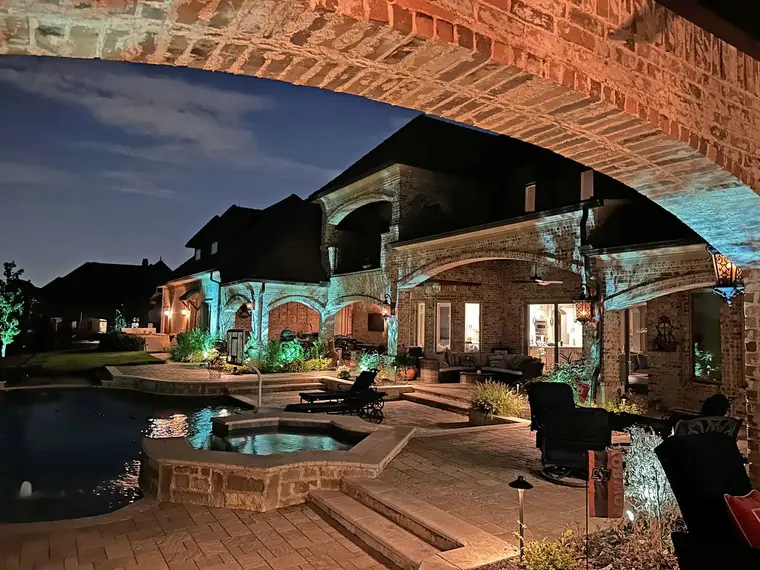
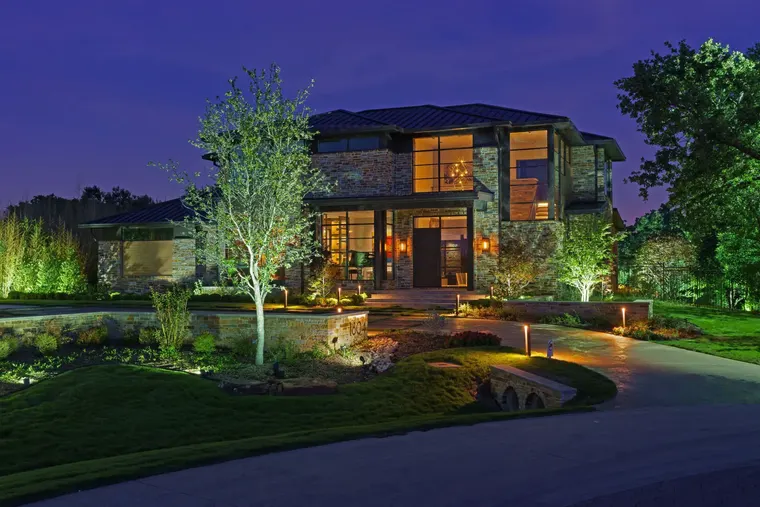
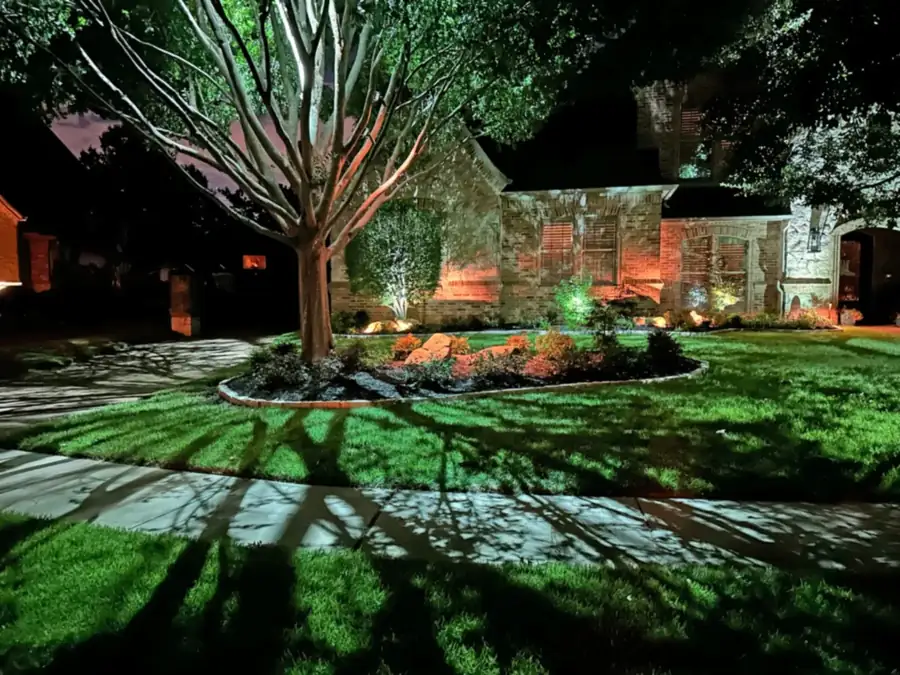
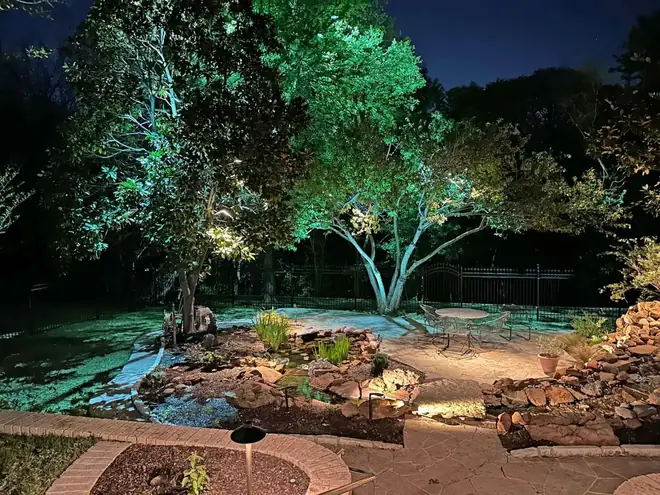
Photographs from TC Lighting installations across the Metroplex. The full set is in the gallery, organised by town.
Two steps, about thirty seconds. Todd designs every project himself and gives you a fixed written price with a start and completion date before any work begins.
Prefer to talk? Call (972) 345-1180.
Two-step form · takes about 30 seconds