Landscape Lighting Design & Installation in Dallas–Fort Worth
The core of what TC Lighting does, and has done for more than forty years — moonlight through the canopy, a warm wash on stone, and pathways you can actually see.
What This Actually Involves
Most landscape lighting fails in one of two ways. It is either too much — a row of fixtures blasting the front of the house until it looks like a car lot — or it is an afterthought, a few path lights pressed into a bed with no thought about what they are for. Neither is design.
A TC Lighting plan starts from the property: which trees have a canopy worth lighting from inside, where the grade falls away, what the stone and brick do with warm light, and how you actually move from the car to the door after dark. Todd walks it in daylight and designs it there and then. Forty years and more than a thousand night-sets are what make that possible — he has seen these effects often enough to know how an uplit live oak or a grazed limestone wall will read once the sun goes down.
Landscape Lighting — The Detail
Three Things the Lighting Has To Do
Every fixture on a property is doing one of three jobs, and a plan that does not know which job each fixture is doing ends up as a scatter of lights that cancel each other out.
Aesthetics comes first: the shadows, the dappled light on a wall or a column, the form of a tree picked out of the dark. This is the part people are actually buying, even when they call and ask about security.
Function is second: steps, walkways, grade changes, the path from where you park to the door you use. Function lighting has a test that aesthetics does not — can a guest who has never been to your house walk it at night without looking down.
Security is third, and it arrives as a by-product rather than as a floodlight. Most people picture security lighting as bright and glaring, something closer to a prison yard. Glare actually works against you: a bright source in the eye destroys night vision and casts hard black shadows for someone to stand in. A property lit evenly at low levels, with no dark voids and no blinding sources, is both more secure and better to look at.
Those three objectives are the frame Todd Cormier has designed to for forty years, and they are why the first question on a design visit is what you do on the property after dark rather than how many fixtures you want.
The Effects, and When Each One Is Right
Landscape lighting has a vocabulary. Knowing which effect suits which subject is most of the difference between a designed property and a lit one.
Moonlighting — the signature
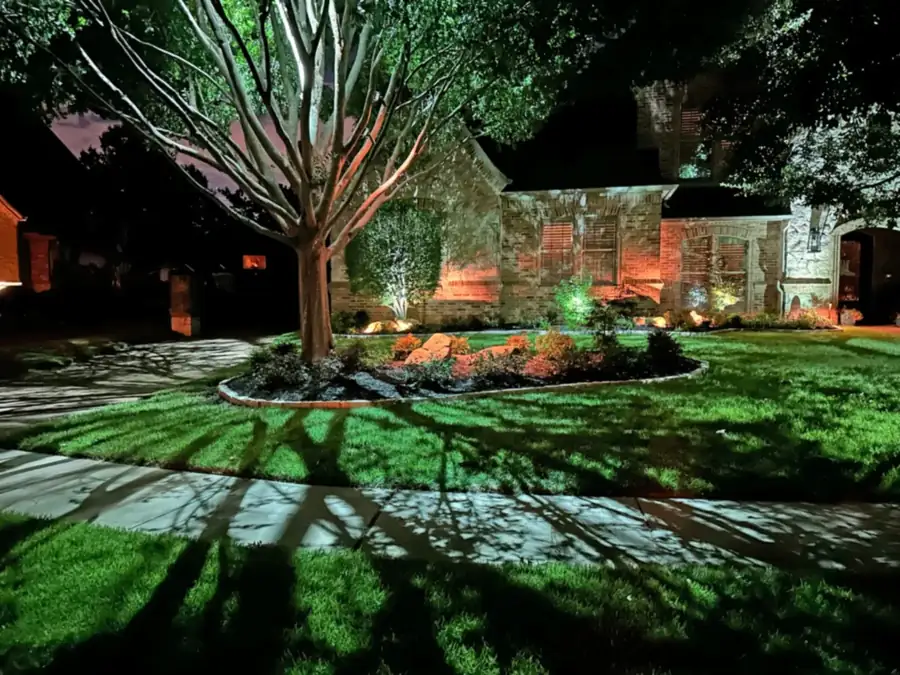
Fixtures mounted high in a mature canopy, aimed down through the branches. What lands on the lawn is not a pool of light but the shadow pattern of the tree itself, moving when the wind moves. It reads as moonlight rather than as a lit yard, and it is the effect TC Lighting clients name more than any other. It is also the effect that originated here in the Dallas metroplex in the 1960s, and the one Todd was trained in.
It only works with the right subject. You need a canopy with structure — live oak, post oak, red oak, cedar elm, pecan — and enough height to mount above the branch you are lighting through. A young tree has nothing to cast. A dense evergreen blocks rather than filters.
Uplighting
A fixture at or below grade throwing light up a trunk, a wall, a column or a multi-trunk crepe myrtle. The aim is to show form and texture, not to flood. The usual mistake is too much lumen too close: a wall washed at full output goes flat and loses the texture that made it worth lighting.
Grazing
The same fixture moved to within a foot or so of a textured surface and aimed nearly parallel to it. On limestone, on a stacked stone wall, on old brick, grazing throws every joint and chip into relief. On a smooth stucco wall it does nothing at all, and will show every trowel mark you did not want to see.
Silhouetting and shadowing
Silhouetting puts the light behind the subject and aims it at the wall beyond, so the plant reads as a black shape against a lit ground. Shadowing does the reverse — light in front, throwing the plant's shadow onto the surface behind. Both need a surface to play against, which is why they work in courtyards and against garden walls and fall apart in an open yard.
Cross-lighting
Two fixtures on opposite sides of a specimen tree at lower output rather than one at full. The subject gets depth instead of a flat lit face, and the shadow it throws stops looking like a stage effect. It costs a fixture. It is usually worth it.
| Beam | Spread | Typical use |
|---|---|---|
| Spot | 10–15° | Tall trunks, columns, reaching 25ft+ into a canopy, tight architectural detail |
| Narrow flood | 20–25° | Single specimen trees, statuary, narrow stone piers |
| Flood | 35–40° | Wall washing, wide shrub masses, multi-trunk crepe myrtle |
| Wide flood | 55–60° | Downlighting from height, broad low planting, hedge lines |
Colour temperature is the other half of the choice. Warm light around 2700K flatters brick, limestone and warm stone. Around 3000K reads cleaner on green foliage, which can go slightly yellow-brown under very warm light. Moonlighting from height is the exception and often wants a cooler source, because real moonlight is cool — that is precisely what gives the effect its soft, silvery quality rather than the look of a porch light in a tree.
You Should See the Light, Not the Fixture
Todd's own description of the work is blunt about this: the craft is using whatever canvas the landscape and the house give you to create the most dramatic effect while simultaneously concealing the source. A visible, glaring fixture undoes the effect it is producing.
Concealment is a set of specific decisions, made fixture by fixture:
- Aim away from the sightlines people actually use. The view from the front door, from the kitchen window, from the seat on the patio where everyone sits, and from the street. A fixture can be perfect from three of those and a glare bomb from the fourth.
- Shrouds and glare guards. An extended cowl on the fixture pushes the visible source back and cuts the angle at which you can see the lamp at all.
- Hex louvers and honeycomb baffles. They cost a little light output and buy a great deal of comfort, particularly on uplights near a walkway.
- Frosted and spread lenses. A frosted lens softens a hot centre spot; a linear spread lens turns a round beam into an oval, which is what a narrow wall or a hedge line actually wants.
- Put the fixture where the planting hides it. The best concealment is not an accessory. It is a fixture set behind a shrub mass, below a wall cap, or tucked into a bed so the housing never enters the frame.
A quick test on any existing system: stand at your own front door after dark and look out. If you can pick out individual bulbs, you are looking at fixtures rather than at your garden, and the system is working against itself.
What Keeps a System Alive for Twenty Years
The design is what you buy. The engineering underneath is what decides whether you are still happy with it in year twelve, or calling somebody to rip it out.
Voltage drop is the thing most systems get wrong
A low-voltage system runs at twelve volts, and voltage falls along the length of the cable. Lose too much and the lamps at the far end run dim, shift colour, or on a halogen system die early. The arithmetic is not mysterious: watts multiplied by distance, divided by a constant for the cable gauge. A hundred feet of 12-gauge carrying a hundred watts gives up roughly 1.3 volts. The same load on 10-gauge gives up about 0.8.
That is why the cable gauge, the run length and the way runs are split are design decisions rather than whatever was on the truck. It is also why a quality transformer has multiple taps — 12, 13, 14 and 15 volts — so a long run can be fed at a higher voltage and still arrive at the fixture in the right window.
| Cable | Drop over 100ft at 100W | Where it belongs |
|---|---|---|
| 14 gauge | ~2.2V | Short spurs only, close to the transformer |
| 12 gauge | ~1.3V | The normal working cable for most runs |
| 10 gauge | ~0.8V | Long runs, heavy loads, the back of a large property |
Transformer sizing and loading
A transformer should be selected with headroom, not filled to its rating. Load it to roughly eighty percent and you have room for the fixtures that get added later — and fixtures always get added later, because once a property is lit properly the owner starts seeing the next thing. A transformer run at its limit runs hot and dies early.
Zoning matters as much as capacity. Splitting the property across multiple circuits means one fault takes out one zone rather than the whole garden, and it makes fault-finding a ten-minute job instead of an afternoon.
Connections are where systems actually fail
The single most common reason an older system dies one fixture at a time is a buried connection that was never meant to be buried. A twist-on wire nut pushed into the soil wicks moisture, corrodes the copper green, and goes high-resistance long before it goes fully open — so the symptom is a dim fixture months before it is a dead one. Every connection belongs in a purpose-made, gel-filled or heat-shrink-sealed joint.
Conduit
Bare low-voltage cable buried at six inches is the industry norm, and it is why a great many systems in this metroplex start failing around year ten. It gets cut by a landscaper's edger, speared by a bed-renovation shovel, nicked by core aeration, and chewed by rodents. TC Lighting runs its cable in conduit. It costs more on day one and it is the main reason our repair calls are nearly always on somebody else's work.
What North Texas Does to Outdoor Lighting
A lighting system installed in Dallas-Fort Worth is not living the same life as one in San Diego. Four local conditions do most of the damage here, and all four are designed around rather than hoped about.
Blackland Prairie clay
Most of Dallas, Collin and eastern Denton counties sit on the Blackland Prairie — dark, high-plasticity clay that swells when it rains and shrinks hard in an August drought, opening cracks you can lose a tape measure in. The consequences for a lighting system are direct. Fixtures on short stakes heave and lean, so a path run that was dead straight in April is a drunken scatter by September. Cable pulled tight across moving ground goes into tension it was never meant to carry. The answers are stake depth appropriate to the soil, slack deliberately left in every run, and re-setting as part of maintenance rather than as an emergency.
West and north-west of the Trinity the ground changes to the sandier Cross Timbers — easier digging, far less heave, and a different set of trees above it. The same property specification does not suit both, which is one practical reason a design visit happens on your ground rather than over the phone.
Heat
A hundred-degree afternoon is hard on electronics. LED lamps and drivers lose life fast when they cannot shed heat, which makes fixture material and thermal design a durability question rather than a cosmetic one. Solid brass and copper fixtures shed heat, take the weather, and patina rather than corrode. Thin cast aluminium and plastic housings are cheaper, run hotter, and are what you find on the systems we are called out to replace.
Freeze
February 2021 was a reminder that this region does get hard freezes, and that anything holding water when the temperature collapses is at risk. Fixtures that have taken on water through a failed gasket crack. Sealed fixtures, properly gasketed, drained and mounted so water cannot pool in them, come through it.
Hard water and dust
North Texas water is hard, and any fixture inside the throw of a sprinkler head will film over with mineral deposit. A lens with a haze on it can lose a serious fraction of its output, and the usual complaint — "the lights seem dimmer than they were" — is very often nothing but scale and dust on glass. Lens cleaning is part of maintaining a system here, not an upsell.
From the First Visit to the Night Set
The design visit happens in daylight
Asked to come back after dark and walk the property before drawing anything, Todd tends to say he cannot see in the dark either — and that it would take a tremendous amount of time. What lets him design in daylight is more than a thousand night sets over forty years. Having stood on that many properties watching the effect come up, he can see the finished result while the sun is still out, and design to it.
The visit is free, on your property, and it is Todd who comes. You get a plan and a fixed written price with a start date and a completion date, given alongside the bid rather than after it.
Every fixture is spotted and day-set before installation
Before anything goes in the ground, each fixture location is spotted and the fixture is day-set — positioned and aimed in daylight, against the plan. This is the step that separates an installation from a delivery of boxes.
Then the night set
The majority of projects then get a night set after dark, which typically means one or two adjustments rather than a wholesale re-aim — because the day set was done properly. On smaller projects it is sometimes not necessary at all. Todd likes being there for it: watching a client see their property lit for the first time is the part of the job he enjoys most.
One client in Streetman described the whole of their adjustment visit — what they called the night set — as finished in under three hours. That is what a proper day set buys you.
How To Compare Two Landscape Lighting Bids
Two bids on the same property can differ by a factor of three, and the reasons are rarely on the page. If you are comparing quotes — ours or anyone's — these are the questions that expose the difference.
- Is the contractor a licensed electrical contractor? Landscape lighting is electrical work. In Texas a licensed electrical contractor holds a TECL number that you can verify with the Department of Licensing and Regulation. A great many lighting installers do not hold one. TC Lighting is TECL 41495.
- What is the fixture made of? Solid brass and copper against cast aluminium or plastic is the single biggest driver of what the system looks like in year ten.
- How is the cable protected? Direct burial or conduit. Ask directly, because it is the difference between a repair call in year ten and one in year twenty.
- How are connections made and sealed? If the answer involves wire nuts underground, keep looking.
- How is the transformer sized? Ask what percentage of its rating the design loads it to, and whether there is capacity for additions.
- Is there a night set, and is it included? Aiming is where a design either lands or does not.
- Are the start and completion dates in writing, with the price? Ours are, on the bid.
- Who is actually on your property? Ask whether the person designing it will be there during the install. On our projects Todd is there each day, with Augustine running the crew.
A bid that is materially cheaper is usually cheaper for a findable reason: aluminium instead of brass, direct burial instead of conduit, no night set, a transformer with no headroom, and a salesman rather than a designer on the walk-through.
Recent Work
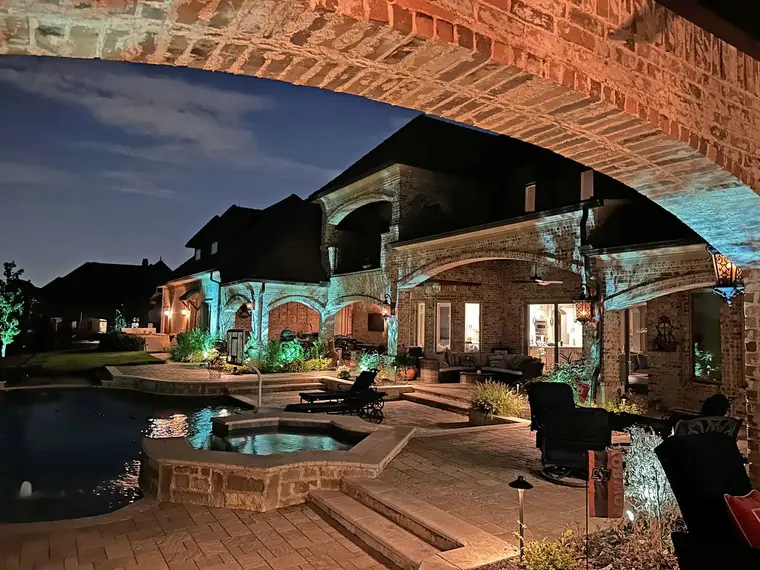
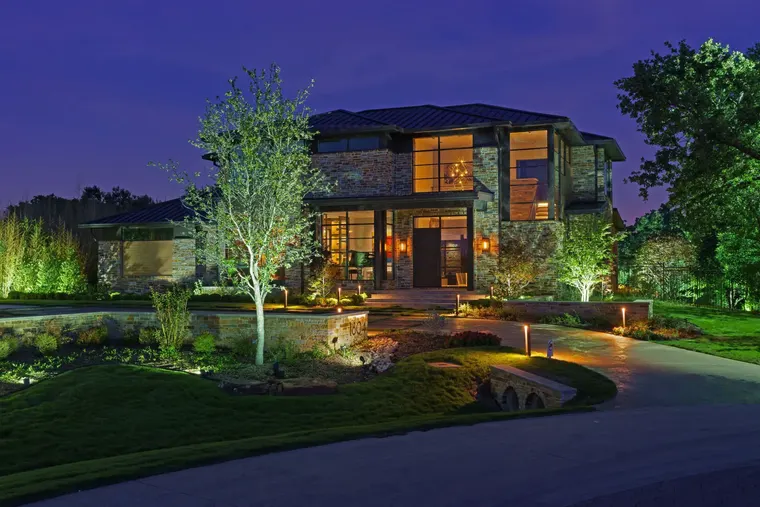
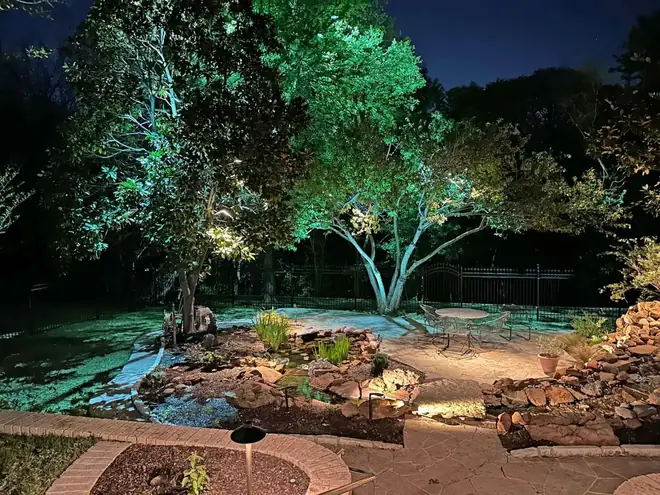
Photographs from TC Lighting installations across the Metroplex. The full set is in the gallery, organised by town.
Across Five Counties, From Carrollton
Whether you're under the old post oaks in Preston Hollow, on a long frontage out toward Southlake, or on a sloped lot above Grapevine Lake, the design visit is free and the plan is written before anything goes in the ground. The tree cover north of Northwest Highway is why moonlighting reads so well in that part of Dallas; the open lots west of the Trinity are why transformer placement has to be worked out before the first trench, not after.
Frequently Asked Questions
It depends almost entirely on the property: how many trees are worth lighting, how much frontage there is, how far the cable has to run, and whether any existing infrastructure can be reused. That is why the design visit is free. Todd walks the property in daylight, builds the plan around what is actually there, and gives you a fixed number with a start and completion date before any work begins.
Moonlighting means mounting fixtures high in a mature tree and aiming them down through the branches, so the light reaching the ground carries the shadow of the canopy. It reads as natural moonlight rather than a lit yard. It works particularly well in older Dallas neighbourhoods like Preston Hollow, where the post oaks and live oaks have the forty-foot canopies the effect depends on.
Most residential projects run from a few days to a couple of weeks, depending on the size of the property and how much trenching and conduit is involved. You get a start date and a completion date with the bid. Reviews going back years say the same thing: TC Lighting started on time and finished on schedule or early.
Yes. TC Lighting works on residential and commercial properties across Dallas, Tarrant, Collin, Denton and Navarro counties, and holds Texas Electrical Contractor License TECL 41495, which covers line-voltage site and pole lighting as well as low-voltage landscape work.
For a standard twelve-volt low-voltage system, generally no, though the transformer's line-voltage supply is electrical work and some municipalities have their own requirements. Requirements genuinely differ between cities in this metroplex, so it is checked for your jurisdiction rather than assumed. TC Lighting is a licensed Texas electrical contractor, TECL 41495, which is what lets us do the line-voltage side properly.
The lamps are no longer the limiting factor. An LED lamp is rated around 40,000 hours, so at six hours a night it is measured in decades rather than years. What actually determines system life is the things around the lamp: solid brass or copper fixtures rather than cast aluminium, connections sealed for burial, cable protected in conduit rather than buried bare, and a transformer that was sized with headroom instead of loaded to its limit.
It depends on what is being lit. Warm light around 2700K flatters brick, limestone and warm stone. Around 3000K reads cleaner on green foliage, which can go yellow-brown under very warm light. Moonlighting down through a canopy is the exception and often wants a cooler source, because real moonlight is cool, and that is exactly what gives the effect its soft silvery quality rather than the look of a porch light up a tree.
Not when it is installed correctly. The risks are mechanical rather than from the light itself: hardware fixed tight around a trunk or limb becomes a problem as the tree grows, and cable run without slack goes into tension. Fixtures mounted in a canopy for moonlighting are installed with allowance for growth and revisited as part of maintenance, which in North Texas also means re-aiming as the canopy fills in.
Other Things We Install
LED Conversion & Retrofit
Rusted boxes, failed transformers, a system that has been limping for years. We repair what is worth keeping and convert the rest to LED.
Repair & Maintenance
A good share of our work starts as a service call on somebody else’s system. Several twenty-year clients started exactly that way.
Pole, Site & Hardscape Lighting
Parking areas, drives, retaining walls, steps and seating. The lighting that is about getting around the property safely as much as how it looks.
All Services
Everything TC Lighting designs, installs and services, in one place.
Ask About Landscape Lighting
Two steps, about thirty seconds. Todd designs every project himself and gives you a fixed written price with a start and completion date before any work begins.
- Free, no-obligation design visit and written plan
- Licensed Texas Electrical Contractor — TECL 41495
- Conduit-protected wiring and daily site cleanup
- Every fixture day-set, and a night-set on most projects
Prefer to talk? Call (972) 345-1180.
Request Your Free Design Visit
Two-step form · takes about 30 seconds