LED Conversion & Retrofit for Dallas–Fort Worth Landscape Lighting
Rusted boxes, failed transformers, a system that has been limping for years. We repair what is worth keeping and convert the rest to LED.
What This Actually Involves
A lot of the systems we are called to are fifteen or twenty years old, halogen, and failing a fixture at a time. The owner has usually replaced a few bulbs, found a dead run, and given up. The question is never really “can this be fixed” — it is which parts are worth keeping.
Often more than you would think. Cable runs that were buried properly are usually sound. Transformers can be undersized rather than dead. Fixtures with corroded sockets may have perfectly good housings. We work that out first, then quote a conversion that reuses what is good and replaces what is not, rather than ripping out a whole system on principle.
One client put it plainly: “He used existing stuff where possible, repaired and replaced as needed. The results are beyond what I had hoped.”
LED Conversion & Retrofit — The Detail
What Goes Wrong With an Older Halogen System
If your landscape lighting was installed more than a decade ago it is almost certainly halogen, and it is almost certainly limping. The failure pattern is consistent enough to describe in advance.
Lamps burn out constantly. A halogen MR16 is rated for somewhere around two to four thousand hours. At six hours a night that is two years at best, and in practice less, because every time the lamp is run slightly outside its voltage window the life falls off a cliff. Owners of older systems end up replacing lamps as a routine chore.
Everything runs hot. A 35-watt halogen lamp turns most of that into heat. It cooks its own socket, degrades the gasket and the lens seal, and slowly destroys the fixture around it. Pull the lens off a fifteen-year-old halogen uplight and the discolouration tells the story.
The transformer is at its limit. Halogen draws real power. A twenty-fixture system at 35 watts each is 700 watts before you add anything, which means the transformer has no headroom, runs hot, and has probably already been asked to carry fixtures added later.
Connections have corroded. Fifteen years of North Texas wet-dry cycling on a buried connection that was never sealed properly produces green copper and high resistance — which shows up as dim fixtures at the end of a run long before anything goes fully dark.
What Can Be Saved and What Cannot
A conversion is not automatically a rip-out. A good proportion of an older system is often worth keeping, and the audit decides it component by component rather than by rule.
| Component | Usual verdict | What decides it |
|---|---|---|
| Buried cable | Often reusable | Gauge, insulation condition, and whether it has been nicked. Worth testing rather than assuming either way. |
| Brass and copper fixtures | Frequently worth keeping | Solid brass bodies outlive their lamps by decades. Sockets and lenses may need replacing; the housing is often fine. |
| Aluminium and plastic fixtures | Usually replaced | Fifteen years of heat and weather generally finishes them. Cracked lenses and failed gaskets are the tell. |
| Transformer | Usually replaced | Sized for the old halogen load and often already tired. The new load is a fraction of it, so the sizing changes completely. |
| Buried connections | Replaced | Any connection old enough to convert is old enough to redo properly. |
Retrofit lamp or new fixture
Where a fixture body is sound, dropping in an LED lamp is the cheap, fast option and it genuinely works. Where the body has gone, a purpose-built LED fixture is better in every respect — the thermal design is built around the diode instead of around a lamp that no longer exists, and the optics are cleaner.
The honest guidance is mixed and property-specific: retrofit the good brass, replace the failed aluminium, and do not let anyone talk you into replacing a whole system when half of it has twenty years left in it.
Why Converted Systems Sometimes Look Wrong
Here is the failure people do not see coming. A homeowner converts half the property one year and the rest the next, buying lamps from whatever is available at the time. The result is a garden lit in two or three slightly different whites.
LEDs are sorted into bins at manufacture, and two lamps with the same nominal colour temperature on the box can differ visibly. Put them side by side on the same limestone wall and one reads yellow against the other. The human eye is very poor at judging absolute colour temperature and very good at spotting a difference between two adjacent sources — which is exactly the comparison a partial conversion sets up.
Doing it properly means choosing the colour temperature for the property as a whole, deciding it by surface rather than by habit — warmer on brick, stone and architecture, slightly cooler on green foliage, cooler again for moonlighting from height — and then converting in a way that keeps matched lamps together on the same sightlines.
If you are converting in phases for budget reasons, convert by sightline rather than by area. Everything visible in one view should change at once. That single decision prevents most of the mismatch complaints.
What Actually Changes When You Convert
The energy arithmetic is straightforward, and it is only part of the argument.
| Halogen | LED | |
|---|---|---|
| Per fixture | 35W typical | 5–7W for comparable output |
| Twenty fixtures | ~700W | ~120W |
| Rated lamp life | 2,000–4,000 hours | 40,000 hours and up |
| Lamp changes | A recurring chore | Effectively out of the maintenance cycle |
| Transformer headroom | None left | Room to extend the system later |
The electricity saving is real but it is rarely what convinces anyone. The two things that do are never touching a lamp again, and the fact that a system drawing a sixth of its old load suddenly has enough capacity to light the part of the garden you always wanted lit and were told could not be added.
There is one technical detail worth knowing because it changes the design. Halogen lamps are fussy about voltage and want to sit close to twelve volts. LED lamps tolerate a much wider window, commonly somewhere around nine to fifteen volts. That tolerance means voltage drop across a long run stops being the tyrant it was, and a converted system can often be re-tapped and re-zoned more simply than the original ever could.
What a Conversion Involves on the Day
A conversion follows the same shape as a new installation, with an audit in front of it:
- Survey the existing system. What is there, what is still working, what has been added since, and what the cable and connections are actually like under the ground.
- Test before deciding. Voltage at the fixture rather than at the transformer is the number that matters, and it is what reveals the dying connection nobody knew about.
- Recalculate the load. New lamp wattages, new transformer sizing, and the taps and zoning reworked around them.
- Convert, replace and reseal. Retrofit what is sound, replace what is not, and redo every connection properly.
- Re-aim the whole system. This is the step that gets skipped, and it is the one that decides whether the property looks better afterwards. Fifteen years of growth has moved every subject on the property. A tree lit correctly in 2010 is being lit wrongly now regardless of the lamp in the fixture.
- Day set, then night set. The same method as a new install, because a conversion that is not re-aimed is just newer lamps pointed at the wrong things.
Where the survey finds a system worth repairing rather than converting, we will say so. That work sits on the repair and maintenance page.
Recent Work
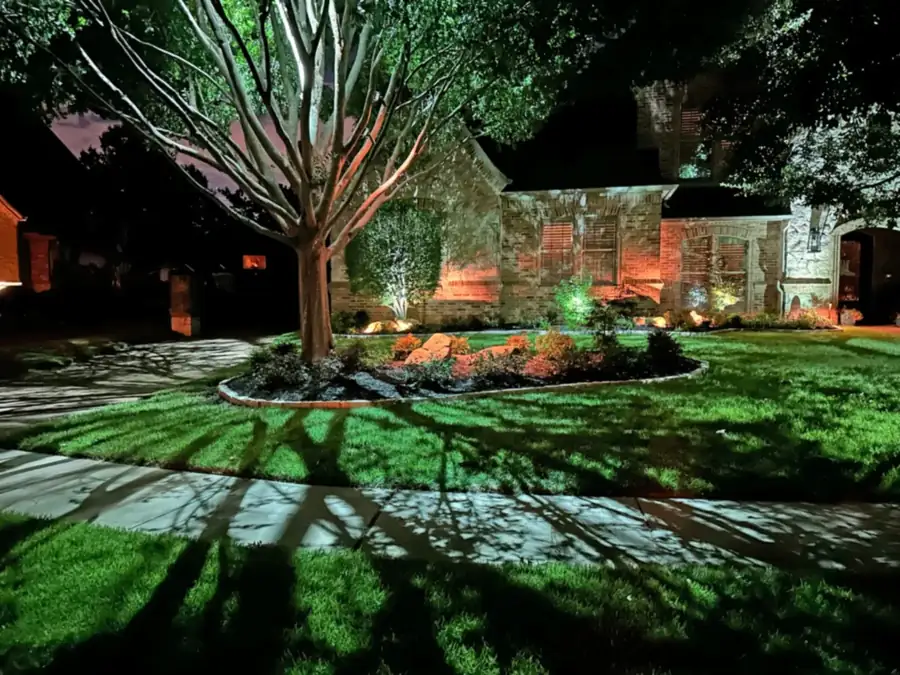
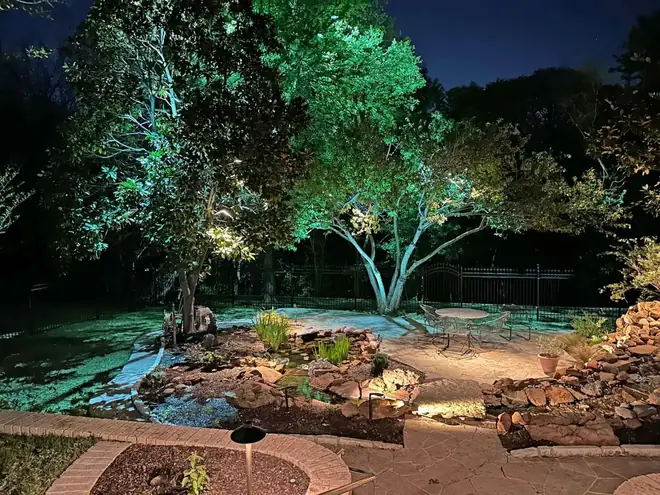
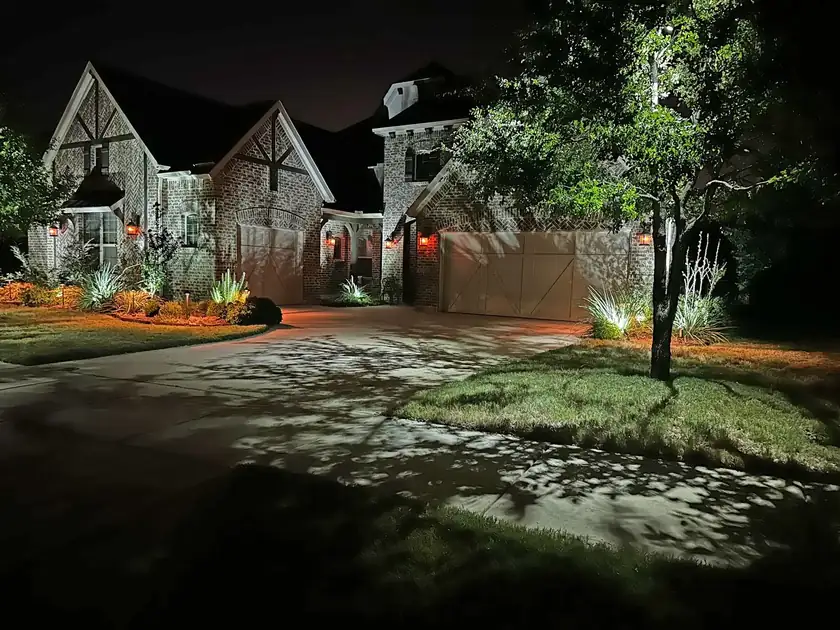
Photographs from TC Lighting installations across the Metroplex. The full set is in the gallery, organised by town.
Across Five Counties, From Carrollton
Whether you're in Preston Hollow with a twenty-year-old halogen system, in Colleyville with a run that dims at the far end, or on a lake lot near Richland-Chambers where the original install gave up years ago, the survey comes first. Blackland clay moves with the seasons across Denton and Collin counties, which is why so many failures trace to cable rather than fixtures.
Frequently Asked Questions
Usually, and usually more of it than you would expect. Cable runs buried properly are often sound, transformers may be undersized rather than dead, and corroded fixtures can have perfectly good housings. We survey first, then quote a conversion that reuses what is good and replaces what is not.
Nearly always the wiring rather than the fixtures. Low-voltage cable buried bare gets nicked by edging and aeration, splices sit in wet ground and corrode, and seasonal movement in North Texas blackland clay works at every weak joint. Anything we put in the ground goes in conduit.
Yes, and it will stay that way. Modern LED landscape lamps are specified by colour temperature, so a warm 2700K source reads much like halogen while drawing a fraction of the power and lasting years rather than seasons.
Rarely. Where existing runs are sound we reuse them, which is the difference between a retrofit and a rebuild. Any new runs go in conduit.
Usually, and often keeping a good part of what is there. Buried cable is frequently reusable depending on gauge and condition, and solid brass and copper fixture bodies often outlive their lamps by decades. Cast aluminium and plastic fixtures generally do not survive fifteen North Texas summers, and a transformer sized for the old halogen load is usually replaced because the new load is a fraction of it. The survey decides each component rather than applying a rule.
The load drops by roughly eighty percent. A twenty-fixture halogen system at 35 watts each draws about 700 watts; the LED equivalent draws around 120. The electricity saving is real, but the two things that actually persuade people are never changing a lamp again, and the fact that a system drawing a sixth of its old load suddenly has the headroom to light the part of the garden they were told could not be added.
Almost always a phased conversion. LEDs are sorted into bins at manufacture, and two lamps with the same colour temperature printed on the box can differ visibly. The eye is poor at judging absolute colour temperature and excellent at spotting a difference between two adjacent sources, which is precisely the comparison a half-converted garden creates. If you are converting in stages, convert by sightline rather than by area so everything visible in one view changes at once.
Usually yes, and for a better reason than age. The old one was sized for a halogen load that no longer exists. There is also a design consequence worth knowing: halogen lamps want to sit close to twelve volts, while LED lamps tolerate a much wider window. That tolerance means voltage drop across long runs stops being the constraint it was, so a converted system can often be re-tapped and re-zoned more simply than the original ever could.
Other Things We Install
Repair & Maintenance
A good share of our work starts as a service call on somebody else’s system. Several twenty-year clients started exactly that way.
Landscape Lighting
The core of what TC Lighting does, and has done for more than forty years — moonlight through the canopy, a warm wash on stone, and pathways you can actually see.
Interior Lighting
The same eye applied indoors — and the same license. Interior design, installation and LED conversion, usually alongside the outdoor work.
All Services
Everything TC Lighting designs, installs and services, in one place.
Ask About LED Conversion & Retrofit
Two steps, about thirty seconds. Todd designs every project himself and gives you a fixed written price with a start and completion date before any work begins.
- Free, no-obligation design visit and written plan
- Licensed Texas Electrical Contractor — TECL 41495
- Conduit-protected wiring and daily site cleanup
- Every fixture day-set, and a night-set on most projects
Prefer to talk? Call (972) 345-1180.
Request Your Free Design Visit
Two-step form · takes about 30 seconds