Pole, Site & Hardscape Lighting in Dallas–Fort Worth
Parking areas, drives, retaining walls, steps and seating. The lighting that is about getting around the property safely as much as how it looks.
What This Actually Involves
Hardscape lighting is where landscape lighting stops being decorative. A long sloped drive, a flight of stone steps, a retaining wall you cannot see the edge of — these are the places where the lighting is doing a job, and where getting it wrong is more than an aesthetic problem.
The same applies to site and pole lighting on commercial properties: a parking area has to be lit to a usable level without throwing glare into a neighbouring window or leaving pools of darkness between poles. TC Lighting works on commercial and residential properties alike, and the electrical side is handled by a licensed Texas Electrical Contractor either way.
Pole, Site & Hardscape Lighting — The Detail
Two Different Jobs Under One Heading
This page covers work at both ends of the scale, and they have almost nothing in common except that both are lighting fixed to hard surfaces rather than planted in a bed.
Pole and site lighting is commercial work: parking areas, drives, loading and service yards, walkways across a site, building surrounds. It is line-voltage electrical work, it involves trenching and concrete bases, and the design is measured in foot-candles and uniformity rather than in effects.
Hardscape lighting is detail work: retaining walls, seat walls, steps and risers, column caps, outdoor kitchens, pool copings and the edges of patios. It is low-voltage, it is built into masonry, and the whole craft is putting light onto a surface without the source ever entering anyone's eye.
TC Lighting does both, residential and commercial, as a licensed Texas electrical contractor — TECL 41495. On the commercial side that licence is not a differentiator, it is the entry requirement.
How Site Lighting Is Actually Designed
A parking area is not lit by putting up poles until it looks bright. It is designed to numbers, and the numbers are about consistency more than intensity.
Level and uniformity
Two properties can have the same average light level and feel completely different. The one that feels unsafe is the one with a poor uniformity ratio — bright pools under each pole and dark voids between them. Your eye adapts to the bright patch and then cannot see into the dark one. A well-designed site runs at a modest average with the ratio between brightest and darkest kept tight, which is why it feels safe without feeling like a stadium.
Pole height, spacing and distribution
Height and spacing are a single decision. Taller poles cover more ground per pole and give better uniformity; shorter poles need tighter spacing and more of them. The distribution pattern of the fixture — which way the light is thrown and how far — is chosen for where the pole sits: a pole at the edge of a lot against a property line needs a completely different optic from one in the middle of an aisle.
Cutoff and light trespass
Full-cutoff fixtures put light where it is wanted and not above the horizontal. That matters for three separate reasons: glare into drivers' eyes, light thrown onto the neighbouring property, and sky glow. In this metroplex it also matters because a number of cities have their own outdoor lighting provisions in their codes, and the requirements genuinely differ from one municipality to the next. The jurisdiction is checked as part of the work rather than assumed.
Controls
Photocell for dusk-to-dawn, timers or contactors for zones that do not need to run all night, and the option of stepping levels down after closing rather than running everything at full until dawn.
Why This End of the Work Is a Different Trade
Low-voltage garden lighting runs at twelve volts and the worst outcome of a mistake is a dim fixture. Site lighting runs at 120 or 277 volts, in conduit, underground, on a commercial property. The worst outcome is categorically different, and the work is regulated accordingly.
What it involves:
- Circuit design and panel work — load calculation, breaker sizing, conductor sizing for the run length, and grounding.
- Trenching and conduit at code depth, with pull points that make the system serviceable in ten years without excavating the lot again.
- Pole bases. On Blackland Prairie clay this deserves attention: expansive soil moves, and a base designed for stable ground is a pole with a lean in it five years later. Depth and diameter are specified for the soil that is actually there.
- Wind loading. A pole and fixture assembly presents a sail area, and North Texas gets real wind. The pole, the base and the bolt pattern are matched to the fixture's effective projected area rather than eyeballed.
- Inspection. Permitted and inspected where the jurisdiction requires it, which on commercial work it generally does.
Light on the Surface, Never in the Eye
Hardscape lighting is the most easily botched category in outdoor lighting, because the fixtures sit at eye level or below and there is nowhere to hide a mistake.
Under-cap wall lighting
A linear fixture tucked beneath the cap of a seat wall or retaining wall, throwing light down the face of the stone. Done right you see a graded wash on the masonry and no source at all. Done wrong — mounted too far forward, or with the wrong beam — you get a scalloped row of hot spots and a visible strip of glare from every seat on the patio.
Step and riser lighting
The one place in outdoor lighting where function beats aesthetics outright. A step needs its tread edge legible, which means light across the tread rather than a source shining back at whoever is descending. Recessed riser fixtures and under-nose linear fixtures both work; a path light aimed at the stairs does not, because it lights the user's eyes instead of the step.
Columns, piers and outdoor kitchens
Column caps and pier lights that read as architecture rather than as fittings. In an outdoor kitchen the requirement changes again: you need genuinely usable task light on the work surface and the grill, at a colour temperature that does not make food look grey, and it has to be positioned so the cook is not working in their own shadow.
Built in, not added on
Hardscape lighting is far easier and considerably better when it is planned with the masonry, because conduit, chases and fixture pockets can be built in as the wall goes up. Retrofitting into finished stone is possible — we do it regularly — but if there is a patio or wall going in, the time to have this conversation is before it is built.
What Goes Wrong on These Projects
- Lighting a car park to a brightness nobody needs while leaving the walkway from the far spaces to the door in shadow. Uniformity beats intensity.
- Glare across the property line. The most common source of complaints from neighbours, and almost always fixable with the right optic or a shield rather than with fewer fixtures.
- Steps lit from the wrong side, so the person descending is looking into the source and cannot read the tread edge.
- Wall lights mounted too far out from the face, producing scallops and visible sources instead of a wash.
- Pole bases specified for the wrong soil, which shows up as leaning poles after two or three wet-dry cycles.
- No thought about servicing. A fixture that needs a lift and a lane closure to relamp will not get relamped.
Recent Work
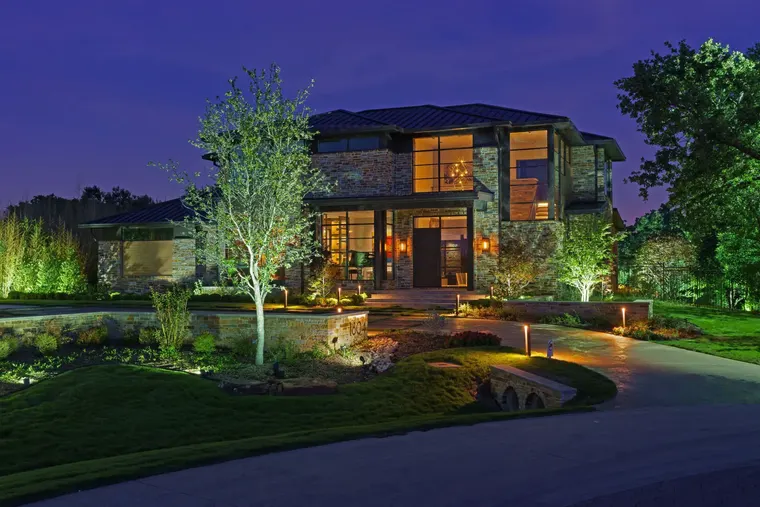
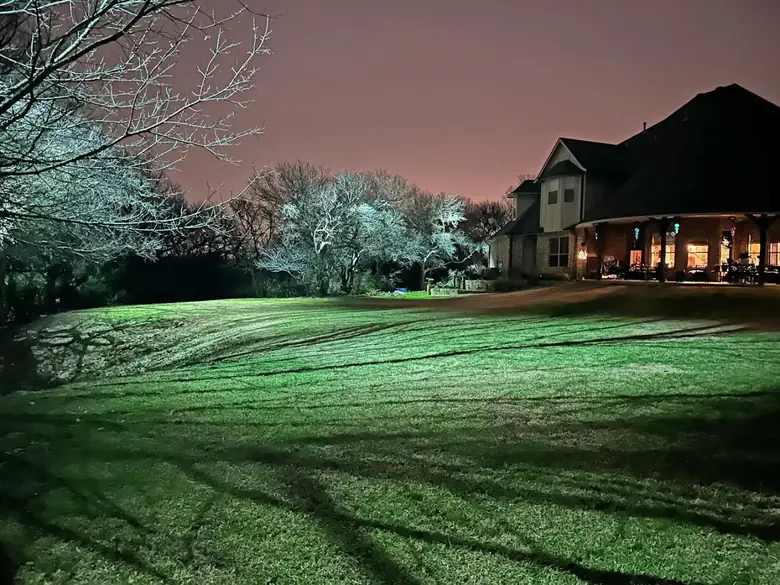
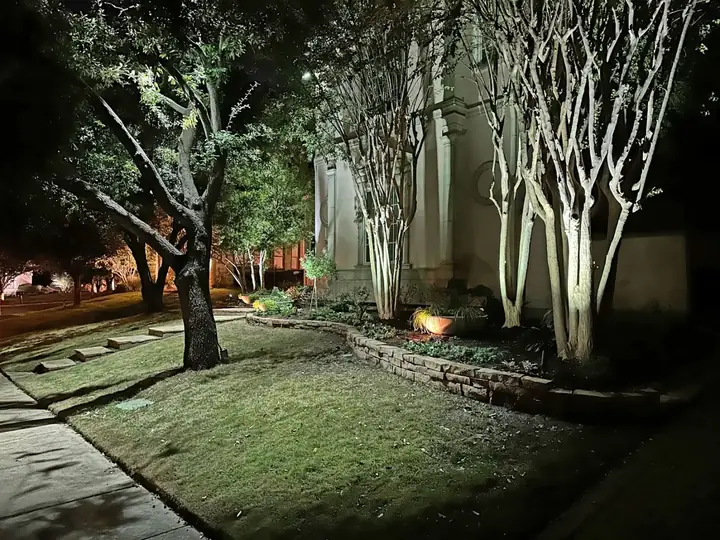
Photographs from TC Lighting installations across the Metroplex. The full set is in the gallery, organised by town.
Across Five Counties, From Carrollton
Whether you're lighting a motor court in Argyle, a stepped garden above Grapevine Lake, or a commercial lot off the LBJ Freeway, the question is the same: what has to be visible to move around the property safely. Long sloped drives are common on the Denton County lake lots, and they are where step and wall lighting stops being decorative.
Frequently Asked Questions
Lighting built into the built elements of a property rather than the planting: retaining and seat walls, steps, level changes, drives and motor courts. On a sloped lot it stops being decorative and becomes how you get from the car to the door safely.
Yes. TC Lighting works on commercial and residential properties, and pole and area lighting is line-voltage work covered by Texas Electrical Contractor License TECL 41495. The aim is even coverage without glare into neighbouring windows or dark gaps between poles.
Because they are the places where not seeing costs you something. A flight of stone steps or an unlit wall edge is the single most useful place to put light on a property, and the one most often skipped.
Often, yes, provided the transformer has capacity and the runs can take it. That is one of the first things we check on the design visit.
Consistency matters more than intensity. Two sites with the same average light level feel completely different if one has bright pools under each pole and dark voids between them, because your eye adapts to the bright patch and then cannot see into the dark one. A well-designed site runs at a modest average with a tight ratio between the brightest and darkest points, which is why it feels safe without feeling like a stadium.
A full-cutoff fixture emits no light above the horizontal, so the light goes to the ground rather than into the sky, the neighbours' windows, or drivers' eyes. It matters for glare, for light trespass across a property line, and for sky glow. Several cities in this metroplex also carry outdoor lighting provisions in their codes, and the requirements differ between municipalities, so the jurisdiction is checked as part of the work.
No, but it is easier and better when it is, because conduit, chases and fixture pockets can be built in as the masonry goes up. Retrofitting into finished stone is routine work for us. If there is a patio, wall or outdoor kitchen going in, the time to have the lighting conversation is before it is built rather than after.
Because they are lighting the user rather than the step. A step needs light across the tread so the edge is legible; a fixture aimed back at whoever is descending puts a source in their eyes and destroys the contrast that makes the tread edge visible. Recessed riser fixtures and under-nose linear fixtures both solve it. A path light pointed at the stairs does not.
Other Things We Install
Landscape Lighting
The core of what TC Lighting does, and has done for more than forty years — moonlight through the canopy, a warm wash on stone, and pathways you can actually see.
Interior Lighting
The same eye applied indoors — and the same license. Interior design, installation and LED conversion, usually alongside the outdoor work.
Repair & Maintenance
A good share of our work starts as a service call on somebody else’s system. Several twenty-year clients started exactly that way.
All Services
Everything TC Lighting designs, installs and services, in one place.
Ask About Pole, Site & Hardscape Lighting
Two steps, about thirty seconds. Todd designs every project himself and gives you a fixed written price with a start and completion date before any work begins.
- Free, no-obligation design visit and written plan
- Licensed Texas Electrical Contractor — TECL 41495
- Conduit-protected wiring and daily site cleanup
- Every fixture day-set, and a night-set on most projects
Prefer to talk? Call (972) 345-1180.
Request Your Free Design Visit
Two-step form · takes about 30 seconds