Landscape Lighting Repair & Maintenance in Dallas–Fort Worth
A good share of our work starts as a service call on somebody else’s system. Several twenty-year clients started exactly that way.
What This Actually Involves
Low-voltage lighting fails in a small number of predictable ways, and most of them trace back to how the system was installed rather than to the fixtures. Cable buried bare gets nicked by an edger or an aerator. Splices sit in wet ground and corrode. A transformer that was marginal on day one gives up. A run that was too long was always going to dim at the far end.
We diagnose before we quote. Sometimes the answer is a single connection; sometimes it is a retrofit. Either way you get told which, and why. Emergency service is available for some situations — call and tell us what has happened and we will tell you honestly whether it needs someone tonight.
Repair & Maintenance — The Detail
What Actually Fails, In Order of Likelihood
Landscape lighting fails in a small number of well-understood ways. After forty years the diagnosis is usually quick, because the symptom narrows the cause.
Corroded connections — the most common cause by a distance
A buried connection that was not sealed for burial wicks moisture, corrodes, and goes high-resistance. Because resistance climbs gradually, the symptom is a fixture that got dim over a season rather than one that died overnight. Owners often blame the lamp, replace it, and get three more months before the same fixture dims again.
Cut cable
Directly buried cable in a working garden gets cut. An edger along a bed line, a shovel during a planting change, a core aerator in the autumn, a fence post, a new irrigation run. The symptom is sharp and specific: everything downstream of one point goes dark at once.
Water in the fixture
A failed gasket or a cracked lens lets water into the housing. In summer that shows up as a fogged lens and a corroded socket. In a hard freeze it can split the fixture outright. Fixtures sitting in the path of a sprinkler head are the usual casualties.
Transformer failure
Everything off at once, or one zone off at once, points at the transformer or its breaker. Transformers that were loaded to their limit from day one fail years earlier than ones that were sized with headroom.
Voltage drop from fixtures added later
Somebody adds six fixtures to the end of an existing run. Now the far end of that run sits below the voltage the lamps want, and the last few fixtures are dim, colour-shifted, or dying early. Nothing is broken. The system was simply asked to do more than it was designed for.
Lamps
Last on the list, because on a halogen system lamps fail constantly and are rarely the interesting problem, and on an LED system they almost never fail at all.
How a Fault Gets Found
Fault-finding on a low-voltage system is methodical rather than mysterious, and the sequence matters because it saves digging.
- Start at the transformer. Is it powered, is the breaker or fuse intact, is it switching, and what is it putting out on each tap.
- Isolate by zone. A properly zoned system tells you where the fault is in minutes. An unzoned one — everything on a single run — is why some repair calls take an afternoon.
- Measure voltage at the fixture, not at the transformer. This is the number that matters and the number nobody checks. Good voltage at the transformer and poor voltage at the fixture means the problem is in between: a corroded connection, a damaged conductor, or a run asked to carry too much.
- Walk the line. Where a cut is suspected, the break is usually findable from the surface — a recent bed change, a new post, fresh irrigation work, an edger line along a bed.
- Then open the ground, once. Diagnosis before digging is the whole point.
Symptom shortcut. One fixture out: lamp, socket or that fixture's connection. A run out from a point onward: a cut or a failed connection at that point. A whole zone out: transformer tap, fuse or zone wiring. Everything dim at the far end: voltage drop, usually from added fixtures. Everything out: power, timer or transformer.
Most of Our Repair Calls Are on Somebody Else's Work
That is not a boast so much as an explanation of what we see. A large share of the repair work TC Lighting does is on systems installed by other companies, typically ten to fifteen years ago, and the faults cluster around the same three decisions: cable buried bare instead of run in conduit, connections made with fittings never intended to go underground, and a transformer sized with no headroom.
None of those are exotic failures. They are the predictable consequence of the cheapest version of each decision, arriving on schedule a decade later. It is also why our own installations run cable in conduit — it costs more on day one and it is the single clearest difference between a system that needs us in year ten and one that does not.
Several long-term TC Lighting clients started as a repair call on a fifteen-year-old system somebody else installed.
What Maintenance Actually Consists Of Here
Maintenance on a landscape lighting system in North Texas is a specific short list, and most of it is about the ground and the plants rather than the electrics.
Re-aiming for growth
This is the big one and the one almost nobody does. Plants grow. A fixture aimed perfectly at a young crepe myrtle five years ago is now lighting the inside of a much larger canopy, or lighting past it into a neighbour's window. A tree that was uplit from six feet away has widened and now needs the fixture moved out. Re-aiming an existing system is frequently the cheapest dramatic improvement available to a property.
Re-setting what the clay has moved
On Blackland Prairie soil, fixtures heave and lean through the shrink-swell cycle. A path run that was straight in spring drifts by late summer. Re-setting stakes and straightening runs is routine maintenance here in a way it simply is not in other parts of the country.
Cleaning lenses
North Texas water is hard, and any fixture inside a sprinkler's throw films over with mineral deposit. Add dust and pollen and a lens can lose a substantial share of its output. A very large proportion of "the lights seem dimmer" calls are solved with cleaning alone.
Clearing growth off fixtures
Beds fill in. A fixture swallowed by a shrub mass is lighting the inside of that shrub and nothing else, and it is also running hot in a pocket with no airflow.
Checking connections and the transformer
Inspecting connections, confirming voltage at the ends of runs, checking the transformer is not running hot, and resetting timers and photocells as sunset moves through the year.
When To Call, and When Repair Stops Making Sense
TC Lighting offers emergency service for the situations that genuinely cannot wait — a damaged system with exposed wiring, a transformer or panel problem, a security-critical property left dark, or damage from a storm or a dig.
Equally, part of being useful is saying when a repair is not the right spend. If a fifteen-year-old aluminium system has failing gaskets across the board, a transformer at the end of its life, and buried connections corroding one after another, then repairing it fixture by fixture is paying twice. At that point the honest recommendation is conversion, keeping whatever is genuinely sound — often the cable and the brass — and replacing what is not.
The survey tells you which of those two you are looking at, and it is the same survey either way.
Recent Work
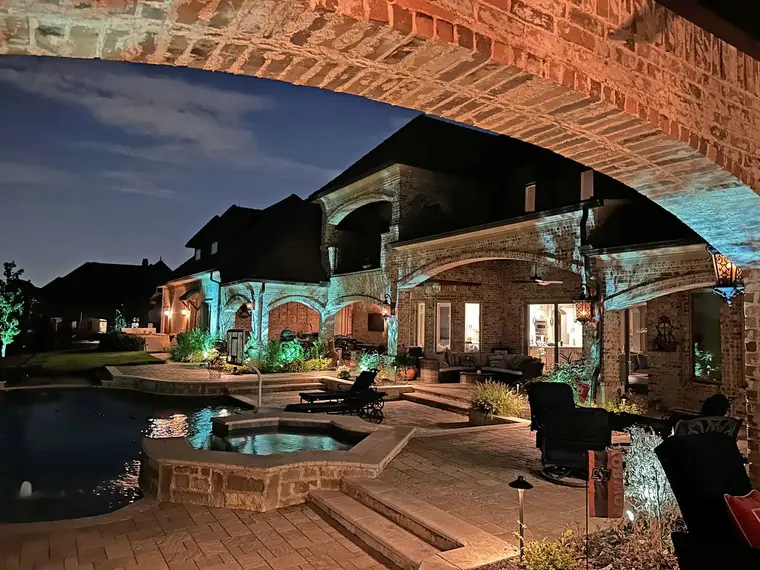
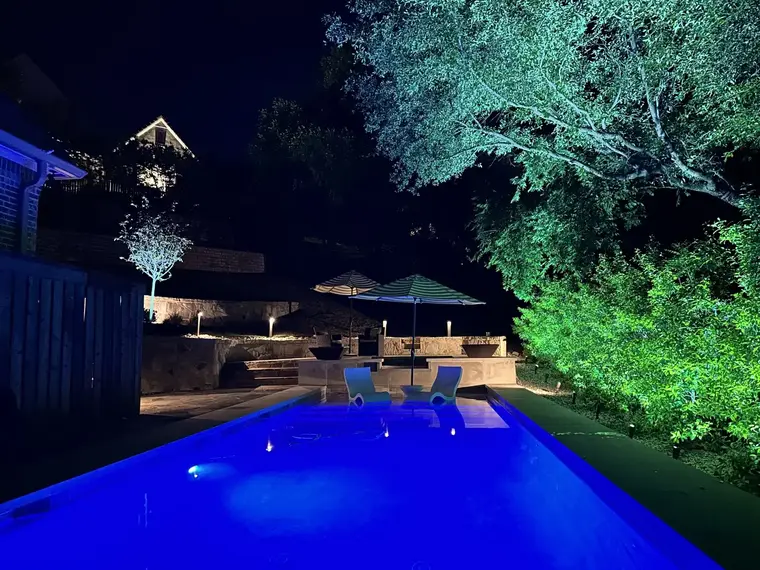
Photographs from TC Lighting installations across the Metroplex. The full set is in the gallery, organised by town.

Across Five Counties, From Carrollton
Whether you're in Dallas, out in Corinth, or over in Fort Worth, we diagnose before we quote. Edging and aeration are the usual culprits on the older Preston Hollow lots, and the seasonal movement in North Texas blackland clay is what finishes off a splice that was never in conduit to begin with.
Frequently Asked Questions
Often, yes, and a good share of our work starts that way. Several long-term TC Lighting clients first called about a fifteen-year-old system that had been failing a fixture at a time.
Emergency service is available for some situations. Call (972) 345-1180 and tell us what has happened, and we will tell you honestly whether it needs someone tonight or can wait for a scheduled visit.
Almost always voltage drop, caused by run length or an undersized transformer rather than by the fixtures. Both are fixable, and diagnosing it properly is the difference between a repair and a repeat visit.
Usually a nicked cable or a corroded splice rather than anything dramatic. Edging, aeration and seasonal ground movement do most of the damage, and bare buried cable is what lets them. We trace the fault rather than guessing at it.
Everything going dark from one point onward almost always means a cut cable or a failed connection at that point. Directly buried cable in a working garden gets cut by an edger along a bed line, a shovel during a planting change, a core aerator in autumn, a fence post or a new irrigation run. A single fixture out is usually its lamp, socket or its own connection. A whole zone out points at the transformer tap, fuse or zone wiring.
Two common causes, and one is free to fix. The first is simply dirty lenses: North Texas water is hard, and any fixture inside a sprinkler's throw films over with mineral deposit that costs real output. The second is voltage drop, usually because fixtures were added to an existing run and the far end now sits below the voltage the lamps want. A corroded buried connection produces the same symptom, since resistance climbs gradually and the fixture dims over a season before it ever dies.
Regularly. A large share of our repair work is on systems installed by other companies ten to fifteen years ago, and the faults cluster around the same three decisions: cable buried bare instead of run in conduit, connections made with fittings never meant to go underground, and a transformer with no headroom. Several long-term TC Lighting clients started as a repair call on somebody else's fifteen-year-old system.
Once a year suits most properties here, and the work is more horticultural than electrical. Re-aiming for growth is the item almost nobody does and the one that makes the most difference, since a fixture aimed perfectly at a young tree five years ago is now lighting the inside of a much larger canopy. Add re-setting the fixtures that Blackland clay has heaved out of line over the shrink-swell cycle, cleaning lenses, clearing growth off fixtures, and checking connections and transformer temperature.
Other Things We Install
LED Conversion & Retrofit
Rusted boxes, failed transformers, a system that has been limping for years. We repair what is worth keeping and convert the rest to LED.
Landscape Lighting
The core of what TC Lighting does, and has done for more than forty years — moonlight through the canopy, a warm wash on stone, and pathways you can actually see.
Pole, Site & Hardscape Lighting
Parking areas, drives, retaining walls, steps and seating. The lighting that is about getting around the property safely as much as how it looks.
All Services
Everything TC Lighting designs, installs and services, in one place.
Ask About Repair & Maintenance
Two steps, about thirty seconds. Todd designs every project himself and gives you a fixed written price with a start and completion date before any work begins.
- Free, no-obligation design visit and written plan
- Licensed Texas Electrical Contractor — TECL 41495
- Conduit-protected wiring and daily site cleanup
- Every fixture day-set, and a night-set on most projects
Prefer to talk? Call (972) 345-1180.
Request Your Free Design Visit
Two-step form · takes about 30 seconds